Situps are one of the best-known abdominal exercises, but there’s often confusion about how to perform them correctly — and whether a situp and a crunch are actually the same exercise.
Both movements work your abdominal muscles, but they aren’t identical.
Important: The free 200 Situps Training Program uses a controlled abdominal crunch, also called a curl-up, rather than a traditional full situp. Throughout the program, when we refer to situps, this is the movement we mean.
Let’s look at the differences and explain how to perform the exercise safely and effectively.
What Is a Situp?
A traditional situp is an abdominal exercise performed while lying on your back with your knees bent. You raise your upper body towards your thighs before lowering yourself back to the floor.
The movement engages several muscle groups, including:
- Rectus abdominis: The abdominal muscles running down the front of your torso.
- Obliques: Muscles along the sides of your abdomen that help stabilize your trunk.
- Hip flexors: Muscles involved in bringing your torso towards your thighs.
Situps can help develop abdominal strength and muscular endurance. However, they aren’t necessarily the best choice for everyone, particularly people who experience discomfort during repeated spinal flexion.
That’s why our training program uses a smaller, more controlled movement.
Situps vs. Crunches: What’s the Difference?
Although people often use the terms interchangeably, there’s an important difference between the two exercises.
Traditional situp
A full situp involves lifting much of your torso away from the floor, bringing your chest towards your knees. Both your abdominal muscles and hip flexors contribute to the movement.
Abdominal crunch or curl-up
A crunch involves lifting your head, shoulders and upper back a short distance from the floor while keeping your lower back relatively stable.
The movement is smaller and emphasizes the abdominal muscles without requiring you to sit all the way up.
Neither exercise is automatically right for everyone. Comfort, technique, individual mobility and any existing back or neck problems should influence your choice.
For the 200 Situps Training Program, use the controlled crunch technique described below. This is the exercise you’ll perform during your Initial Test and throughout the six-week workouts.
How to Perform a Crunch With Good Form
You don’t need any special equipment to get started. A comfortable exercise mat and enough space to lie down are sufficient.
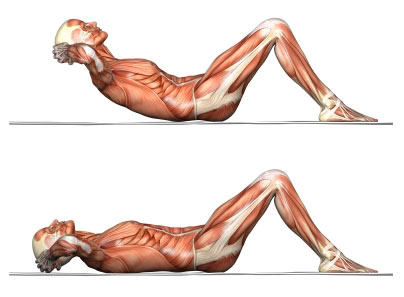
Follow these steps:
- Lie on your back. Bend your knees and place your feet flat on the floor, approximately hip-width apart.
- Position your hands comfortably. Rest your fingertips lightly near your ears or cross your arms over your chest. Avoid pulling on your head or neck.
- Engage your abdominal muscles. Gently tighten your midsection while keeping your movements controlled.
- Lift your shoulders. Exhale as you curl your head, shoulders and upper back a short distance from the floor. Think about bringing your rib cage towards your pelvis rather than trying to sit upright.
- Pause briefly. Hold the raised position for a moment without straining your neck or holding your breath.
- Lower yourself slowly. Inhale as you return your shoulders to the floor, maintaining control throughout the movement.
- Repeat. Perform each repetition steadily, focusing on technique rather than speed.
You don’t need to lift very high to work your abdominal muscles. A small, controlled movement is more useful than trying to force your torso into an uncomfortable position.

Advertisement
How Many Crunches Should You Do?
If you’re new to abdominal exercises, start with a manageable number of controlled repetitions.
For example, you might begin with 5–10 repetitions, rest, and repeat if you can maintain good form.
There’s no need to reach exhaustion during your first session. Your starting level should reflect your current strength and experience.
The 200 Situps Training Program takes the guesswork out of progression by using an Initial Test to help determine which workout column you should follow.
Common Crunch Mistakes to Avoid
Even a simple abdominal exercise can become uncomfortable when performed with poor technique.
Pulling on Your Neck
Avoid gripping the back of your head and pulling yourself upwards. Your abdominal muscles should initiate the movement, not your arms. Keep your hands relaxed and your neck in a comfortable position.
Trying to Sit All the Way Up
Remember that we’re performing crunches, not full situps. There’s no need to lift your entire back off the floor. Concentrate on a smaller movement that you can control.
Moving Too Quickly
Rushing through repetitions often encourages jerky movements and makes it harder to maintain proper technique. Lift and lower your shoulders steadily, without bouncing.
Holding Your Breath
Try to breathe naturally throughout the exercise. Exhale as you curl upwards and inhale as you lower yourself.
Continuing Through Pain
You may feel your abdominal muscles working or becoming fatigued, but sharp pain is not something to push through. Stop if you experience back or neck pain, dizziness, or other concerning symptoms. If you have an existing back condition or are unsure whether crunches are appropriate for you, seek guidance from a qualified healthcare professional.
Can Crunches Help Build a Stronger Core?
Yes. Crunches can help strengthen the abdominal muscles and improve local muscular endurance when performed consistently and with appropriate progression.
However, they’re only one part of a balanced fitness routine.
Other movements, including planks, bird dogs and side planks, can train your trunk in different ways. Walking, running, resistance training and general physical activity also contribute to overall fitness.
It’s also worth remembering that crunches don’t specifically burn fat from your stomach. Visible abdominal definition depends on several factors, including overall body composition.
The goal of our program is straightforward: progressively improve your abdominal strength and endurance through regular, manageable workouts.
Frequently Asked Questions About Situps and Crunches
Are situps and crunches the same?
No. A traditional situp raises most of your torso toward your knees, while a crunch curls your shoulders and upper back a short distance off the floor. Our 200 Situps Training Program uses the controlled crunch described above.
Should you do 200 situps every day?
Not necessarily. More repetitions aren’t automatically better, especially if your technique deteriorates. Our six-week challenge schedules three sessions per week with recovery days in between. You can repeat a week or adjust the workload to your ability. For a more detailed answer, read Is Doing 200 Situps a Day Good for You?.
Will situps give you visible abs?
Situps and crunches can build abdominal strength and endurance, but they don’t selectively remove belly fat. Visible abdominal definition depends on factors such as overall body composition, not the number of situps alone.
Ready to Take the 200 Situps Challenge?
Now that you know how to perform the crunch movement used in our program, you’re ready to get started.
The free 200 Situps Training Program follows a progressive six-week schedule, with three workouts each week and recovery days between sessions.
Start by completing the Initial Test. Your result will help you select the appropriate workout column, so you can begin at a level that suits your current ability.
Step 1: Take the Initial Test →
You don’t need to be particularly strong or experienced to begin. Focus on controlled repetitions, allow yourself time to recover, and build your endurance gradually.
Good luck with the challenge!
Copyright Notice
© 2009–2026 Steve Speirs LLC. All rights reserved.
Unless otherwise stated, the text, images, training materials, and other original content published on TwoHundredSitups.com are protected by copyright.
You may view, download, and print copies of our content for your own personal, non-commercial use, including following the free 200 Situps training program.
Please do not reproduce, republish, distribute, sell, or commercially exploit our original content without prior written permission.
Content credited to third parties remains the property of its respective owners.
For copyright questions or permission requests, please contact us.